
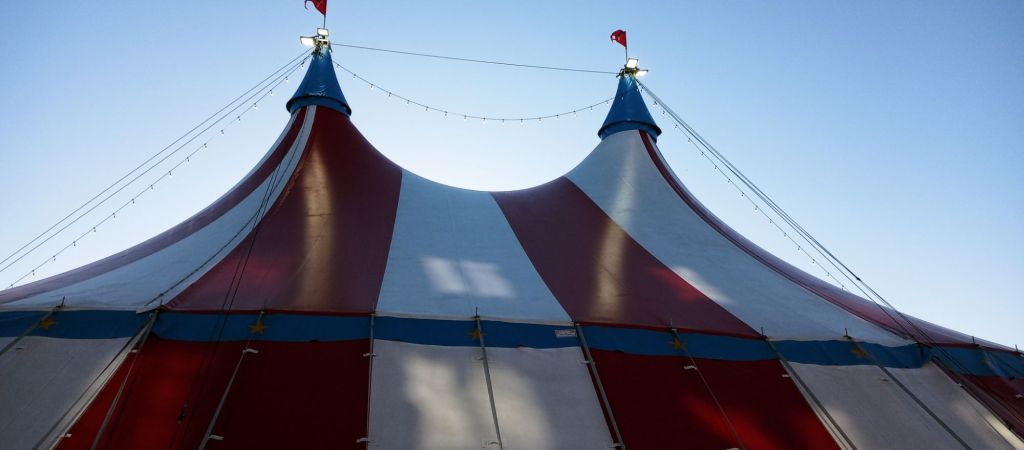
Last night, I went to the circus.
I don’t think I realized that circuses still existed, outside of Cirque du Soleil. When you think of a circus, your mind may conjure up a train of caravans, sprawling tents on open countryside, a lion tamer braving a vicious beast to the awe of an audience on the edge of their seats, a contortionist twisting their body into impossible shapes. Venardos’ Circus (formed by Kevin Venardos, a former Ringmaster for Ringling Bros in 2014) contained elements of these, while also being entirely different. This is a sign of the times, and the progress we have made. For one thing, the wagon caravans of old are hardly an efficient method of travel across a country as vast as the United States. Trailers are far more convenient (and comfortable), so the parking lot was lined with campers and trucks. The site of the circus was not a field in the middle of nowhere, but rather a rare undeveloped plot of land in the middle of town. There were no lions (or elephants, or horses, or any other animal for that matter) to be tamed, and there haven’t been since approximately 2018, when the inclusion of most animals in circuses was banned across the nation.
Circuses as we know them have existed since the 1700s, but there is reason for historians to believe that the concept of the circus has been around since the time of Ancient Rome. It was something for people to look forward to, in an age before movie theaters and organized concert tours. Today, a circus is seen as something quaint, a fun attraction for the kids to attend on a weekend, or perhaps a relic of the past. It proved to be so much more than that, but what it revealed about its audience was as fascinating as any of the feats the performers managed.
Human bodies are something amazing; the flexibility that some people develop, the strength, the sheer, raw power is something to be marveled at. Among the performers was a seventh-generation acrobat, whose family members had come from a long line of circus performers and who had balancing skills that would put a Jenga master to shame. This person – only nineteen years old – had clearly spent an entire lifetime honing his skills; after all, you don’t reach a point where you can stack bar upon bar and plank using nothing but your own arms, or cartwheel backwards into a hoop on a trampoline. This disregard of physics and gravity should be reserved for astronauts and other people whose life’s mission it is to defy the laws of nature, but it was harnessed by a child for our entertainment. Another, a glittering vision of stability and grace, was an aerial hoop performer with clear experience in ballet, if her arm movements and hand motions were anything to go by. She floated – soared – above all of us, all but touching the top of the circus tent with an elegance I rarely see outside of a dance studio. Their comedian (not a clown in the traditional sense, much to my relief) had facial expressions that called to mind Charlie Chaplin or Buster Keaton, the greats of the silent films that came before the Talkies. He had a real skill when it came to setting up a visual punchline and letting his audience in on the joke, and his encouragement of audience participation had me looking forward to the moments in-between acts as much as the acts themselves. (Now is the place where I should confess that if I ever run away to join the circus, I want to be him when I grow up.) The audience, however, seemed – well, not unimpressed, but certainly not as responsive as I felt they had cause to be. Perhaps they were simply too overwhelmed, or their mouths were too busy gaping with shock to properly shout their encouragement. Mine certainly was, at times, and I like to give people the benefit of the doubt when and where I can. However, I fear a much sadder truth may have been the case: they were likely surprised (because who wouldn’t be?) and perhaps a little impressed, but they were so quiet one could hardly tell. And listen, not everyone is naturally reactive. Some people experience the world quietly. But at a performance, that is the time to experience the world as loudly as you are taking it in.
It has occurred to me that we do not live in an interactive society. We experience things, but we rarely partake in them. I could not say whether the Pandemic had anything to do with this, but I do know that for more than a year, concerts were postponed while people stayed at home; the world went digital, and sometimes it feels like we never learned how to log back out. I don’t mean this in the way that older generations like to rag on “kids these days,” about phone addictions and nonsense like that. I simply mean that at some point, we forgot that we are allowed to interact with our surroundings in a way that makes us take up space. We forgot that we don’t have to simply watch the world around us; we can reach out and touch it, scream about it, cheer it on. But what better time to remember than at a performance of skills that serve no other purpose than to showcase the lengths humans are willing to go to become more than ourselves? Personally, I was as delighted by the experience of cheering the performers on as I was in watching them. It feels so good to be part of something, even though I know I will never possess the skill, the strength, the abilities that they do. It’s why I love concerts and plays, those moments of connection between performer and audience members that remind me we are more than individuals forced to remain forever in our own separate bubbles. This is not a world that encourages connection, even though we are more connected than we ever have been, with social media and devices that have us constantly at one another’s beck and call. There are so many ways for us to contact each other that it’s as though we are overwhelmed, and no longer know how.
A circus is such a niche thing. The skills of the performers are nonapplicable anywhere outside of their specialized environment, circus tents are hardly something you can pick up at your local shopping center, and the nomadic lifestyle harkens back to something old-world and magical. The ringmaster, with his rhinestone coat and high top hat, left the audience with the story of his beginnings as the leader of his circus and urging us to find our own dreams and hold onto them – to believe in them – with an earnestness that might have been corny if it weren’t so genuine. (Earnestness is another trait that we as a society are no longer used to, which I think is why we no longer know what to do with it when we are confronted with it. This fact alone tells me that it is desperately needed.)
 K. Elizabeth Fitzgerald